
Mamu
Things To Know
The Rainforest
With more than 4m of rain each year
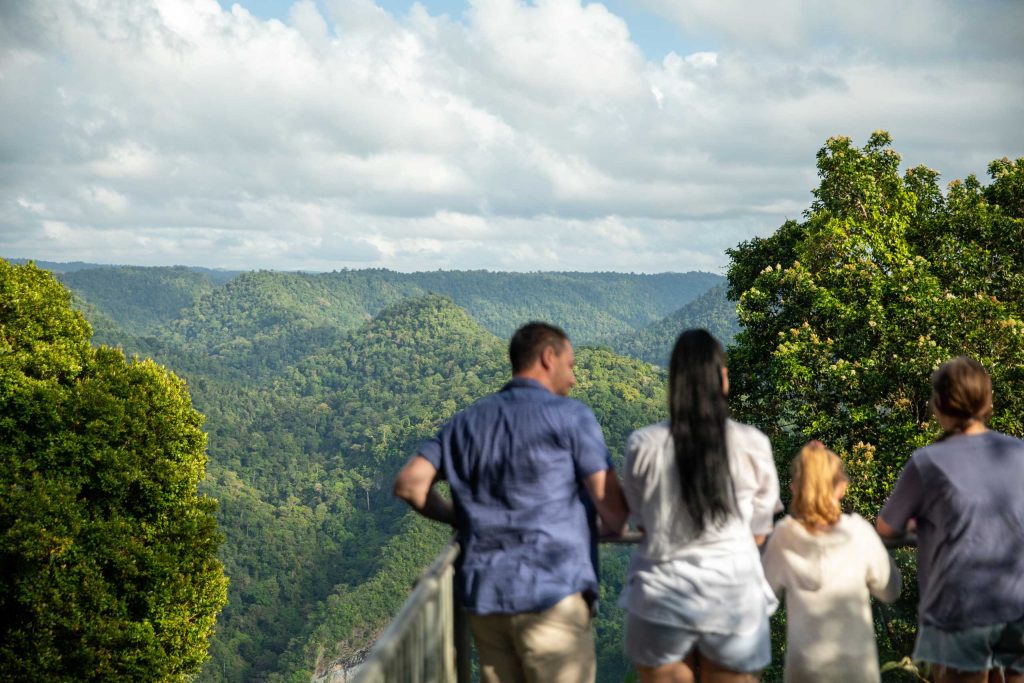
The geology and terrain of the landscape have created conditions ideally suited to the development of rainforest. Basalt rocks weathered to produce fertile, deep red-brown soils; the surrounding high mountains intercept moist winds from the ocean and more than 4m of rain falls each year. At this relatively low altitude (330 m) the climate remains warm all year round.
Not all rainforests are the same. The most complex rainforests have developed in areas with the highest rainfall, the richest, most fertile soils and a warm climate. The rainforest in the Palmerston area is one of the most complex, diverse and species-rich in Australia.
Known as complex mesophyll vine forest, it has the largest variety of plants, the tallest trees bearing the largest leaves, with the most vines, ferns and epiphytes.
The Palmerston rainforest is particularly important as it represents the largest remaining continuous stand of this forest type growing on basalt soils.
Rainforest
Trees
The canopy in the Mamu rainforest is about 25 m high with the tallest trees emerging above the canopy to a height of about 30 m. Trees that form the closed canopy are long-lived, relatively slow-growing species known as climax species.
The canopy is dominated by Johnstone River hardwoods Backhousia bancrofti, left intact after selective logging early last century. Many other species are also present including satin ashes, silky oaks, tamarinds, figs, mahoganies, walnuts, laurels and beeches.
After a disturbance creates a gap in the canopy, fast-growing short-lived tree species, known as pioneers, appear in the rainforest understorey.
Pioneers such as bleeding hearts (Homalanthus novoguineensis), chinky pines Polyscias murrayi and stinging trees Dendrocnide moroides are readily observed competing for space and light around the elevated walkway and tower.
Many rainforest trees produce fruits—some produce year-round while other species produce fruits only in particular months.
This means that at any time of the year a wide variety of fallen fruits, in many colours and shapes, can be found scattered along the tracks and walkways.
Several trees along the walking tracks produce their flowers and fruits on their trunks (known as cauliflory).
Bumpy satinash Syzygium cormiflorum produce large fluffy white flowers followed by white apple-like fruits from their bumpy trunks. Many Davidson’s plums Davidsonia pruriens grow along the walking tracks; some of these are also trunk-fruiting, producing large dark-purple plums from their trunks as well as their branches.
Strangler figs Ficus spp. can be seen from the elevated walkway. Fig trees germinate in the branches of other trees, sending down roots to the ground while growing up towards the light, overshadowing their hosts. A fig’s roots grow into a living lattice around their host tree, which eventually dies as a result of being out-competed for life-sustaining resources.
Amazing place,
so serene.
Epiphytes
On the tower and skywalk, epiphytes (plants that grow on other plants without harming them) positioned high in the canopy can be viewed more easily than from down on the ground.
Basket ferns Drynaria rigidula and bird’s nest ferns Asplenium australasicum grow on high branches, often forming huge clumps, using humus formed from dead leaves for extra energy.
Orchids, including spider orchids Dendrobium tetragonum with their attractive spider-like flowers, can also be found growing on tree trunks. Orchids’ spongy roots can absorb water and nutrients quickly.
Creepers & climbers
From the vantage point of the skywalk, many kinds of creeping and climbing plants can be seen working their way towards the sunlit canopy.
Native monsteras Epipremnum pinnatum and Rhaphidophora australasica clamber up tree trunks; Rhaphidophoras only germinate in deep shade at the bases of large trees which will support their weight.
Climbing pandanus Freycinetia excelsa, with spiky-edged leaves, throw out long untidy stems that cling to tree trunks with tiny rootlets. Lawyer cane Calamus motii send out prolifically hooked tendrils that reach around until they catch onto something for support.
Candle vines Pothos longipes creep up tree trunks using claw-shaped rootlets. Each ‘leaf’ on these creepers is a flattened stem (containing chlorophyll for photosynthesis) ending with a proper leaf. Supplejacks Flagellaria indica send out curling tendrils at the end of each of their leaves that twine around other vegetation as the plants climb upwards.
Understorey
Plants
Cycads Bowenia spectabilis with shiny dark green fern-like leaves grow prolifically on the forest floor and can be seen along the tracks. Native ginger Alpinia caerulea with bright blue berries in autumn and winter are also common on the shaded forest floor.
Native bananas Musa banksii can be seen from the elevated walkway. Similar in appearance to commercially-grown bananas, native bananas produce fruits—actually banana-shaped berries—that contain many seeds.
Rainforest
Mammals
Several mammal species live in the Palmerston rainforest but are not usually seen during the day. Red-legged pademelons Thylogale stigmatica, a small rainforest wallaby, are active mostly at night, feeding on fallen leaves and fruits. Lumholtz’s tree-kangaroos Dendrolagus lumholtzi browse on leaves during the night and sleep during the day crouched in a sitting position in the crown of a tree or on a branch. Despite their appearance they are efficient tree climbers and spend little time on the ground.
Musky rat-kangaroos Hypsiprymnodon moschatus are small primitive rat-like marsupials that forage on the forest floor in the early morning and late afternoon. White-tailed rats Uromys caudimaculatus forage in the canopy and on the ground mostly at night, gnawing through seeds and nuts as well as fruits and small invertebrates.
Musky rat-kangaroos and white-tailed rats are known to scatter-hoard rainforest fruits well away from where they fell and were collected.
This benefits rainforest trees by dispersing their seeds far and wide. Green ringtail possums Pseudochirops archeri spend most of their time in the canopy feeding exclusively on rainforest leaves, mainly from fig trees.
They are nocturnal, feeding and moving about under cover of darkness and sleeping curled into tight balls on a branch by day.
Spectacled flying-foxes Pteropus conspicillatus camp in the rainforest canopy during the day (although their noisy squabbling indicates they rarely sleep) and fly off at dusk to feed on fruits and flowers.
Rainforest
Reptiles
Several kinds of lizards, including skinks and geckos live at Mamu. During the night, tree-dwelling leaf-tailed geckoes Saltuarius cornutus lie motionless on tree-trunks waiting to ambush insects. Another tree-dwelling lizard, Boyd’s forest dragon Hypsilurus boydii, has a distinctively crested head but is well camouflaged and therefore rarely seen.
‘On the forest floor, the rarely seen prickly rainforest skink Gnypetoscincus queenslandiae hunts for prey in rotting wood, while the ever-present rainbow skinks Carlia spp. are commonly heard and seen rustling through the leaf litter foraging for invertebrates.
Snakes also live in the Mamu rainforest although they are rarely seen. Common tree snakes Dendrelaphis punctulata are slender, agile non-venomous snakes that are active during the day, hunting small birds and reptiles.
They are good climbers and are sometimes seen around the elevated walkway. Jungle carpet pythons Morelia spilota may be seen during the day basking in the sun but are mostly active at night.
A non-venomous snake, carpet pythons ambush and then subdue their prey, including rats and birds, by constriction.
Carpet pythons vary greatly in colour and pattern—the Palmerston variety, known as a jungle carpet python, has very distinctive and striking yellow and black markings. Amethystine (scrub) pythons Morelia kinghorni also live in the Mamu rainforest and can grow to more than 5m in length. In winter, scrub pythons congregate at the bottom of rocky valleys such as Johnstone River gorge. Scrub pythons are rarely seen as they are mostly active at night.
From the vantage point of the elevated walkway, red-bellied black snakes Pseudechis porphyriacus can sometimes be seen sunning themselves on the forest floor. Growing to 2m long, they are iridescent black above with bright red or pink scales along the edge of the belly.
These generally shy snakes are venomous and prey on frogs and small reptiles. Unlike pythons and tree snakes, red-bellied black snakes are ground-dwellers and cannot climb.
Rainforest
Invertebrates
Many kinds of invertebrates (animals without backbones) live in the rainforest and play important roles in the rainforest community. Ants, termites, bees, butterflies, moths, stick insects, beetles, spiders, worms, slugs and snails are rainforest pollinators, decomposers and recyclers as well as sources of food for other animals.
Butterflies including the brilliant blue Ulysses butterfly Papilio ulysses joesa and the distinctive green, gold and black Cairns birdwing butterfly Ornithoptera euphorion are easily seen from the elevated walkway as they flutter about, taking nectar from flowers.
Butterflies begin their lives as caterpillars which are very fussy eaters, feeding on only one or two species of plants.
Birdwing butterfly caterpillars feed on a species of vine that contain toxins to deter predators. The caterpillars are immune to the toxin and store it in their bodies as protection against predators.
Australia’s largest moth, the Hercules moth Coscinocera hercules, is present at Mamu in late winter and spring but is only active at night. The handsome brown wings span up to 30 cm (1 ft) wide. The males have long tapered ‘tails’ on each wing but have a smaller overall wing area than females.
Adult females do not feed and live for about 10 days only—they mate, lay eggs and die shortly afterward. Hercules moth caterpillars are pale green/blue with long yellow spikes and grow up to 12 cm (5 in) long. Their food plant is the bleeding heart tree Homalanthus novoguineensis, common in the Mamu rainforest.
Zodiac moths Alcides zodiaca are readily confused for butterflies because they fly during the day and have large pretty wings patterned with bands of black, blue and tan. They mimic poisonous swallowtail butterflies—which deters predators. Zodiac moth caterpillars feed on the day moth vine Omphalea queenslandiae that grows along the elevated walkway.